How to winterise a caravan: a step-by-step guide
The season is over and the caravan is about to sleep for a few months. A few simple steps, done once, save you nasty surprises in spring: a water heater split by frost, mould in the cushions, a dead battery. Here is everything to do, in order, with a checklist to tick off.
Published on
In short
Before the first frosts, drain the caravan's whole water system: tank, pump and water heater (on a Truma, the FrostControl valve opens by itself at about 3 °C, but open it yourself), and leave the taps open. Against damp, keep the vents clear, leave cupboards and the fridge ajar and put out moisture traps. Take the weight off the wheels with axle stands or pump the tyres up 0.5 bar, chock the caravan and release the handbrake. Charge then disconnect the battery, turn off the gas cylinders and take them out. In France, a caravan can be stored with no time limit on the land of your home, but not for more than 7 days in the same place in the street. Keep your insurance.
- Truma FrostControl valve: Opens at about 3 °C
- Tyres without axle stands: +0.5 bar
- Same place in the street (France): 7 days at most
Drain down the water system before the first frost
Water expands by about 9 % when it freezes. A little left in a pipe, the pump or the water heater is enough to split a part, and you only find the leak in spring, when you refill. Drain everything down before the first frosty nights, even if the caravan is under cover: an unheated barn or shed freezes too.
- The fresh water tank: open the drain plug and leave it open all winter. Run the pump for a few seconds to clear it, then empty or remove its filter if it has one.
- The taps: open every tap and the shower head, and set the mixer taps halfway between hot and cold so both sides drain. Leave them open until spring.
- The water heater: this is the most expensive part to replace. On a Truma, open the drain valve (FrostControl). It opens by itself at about 3 °C when the heating is off, but do not rely on that alone, and it can only be closed again by hand above about 7 °C. On other makes, follow the manual: there is often a separate drain tap or plug.
- The waste water tank: empty it, rinse it with clean water and leave the valve open, with a bucket underneath if the caravan stays at home.
- The toilet: empty and rinse the cassette, let it dry, and empty the small flush tank if it is separate.
Damp and ventilation: winter's real enemy
A caravan shut up all winter suffers less from the cold than from damp: condensation on cold walls, mould in the cushions, a musty smell. The rule is simple: air must be able to move.
- Never block the vents in the floor and roof: they are also there for gas safety, and they keep condensation down.
- Leave cupboards, lockers, the wardrobe and the washroom door ajar. Stand mattresses and cushions on their edges, or take them home with the bedding and curtains if you can.
- Put out one or two moisture traps (crystal tubs), standing in a dish in case they overflow, and empty them each time you visit. On a dry, sunny day, open everything up for an hour or two.
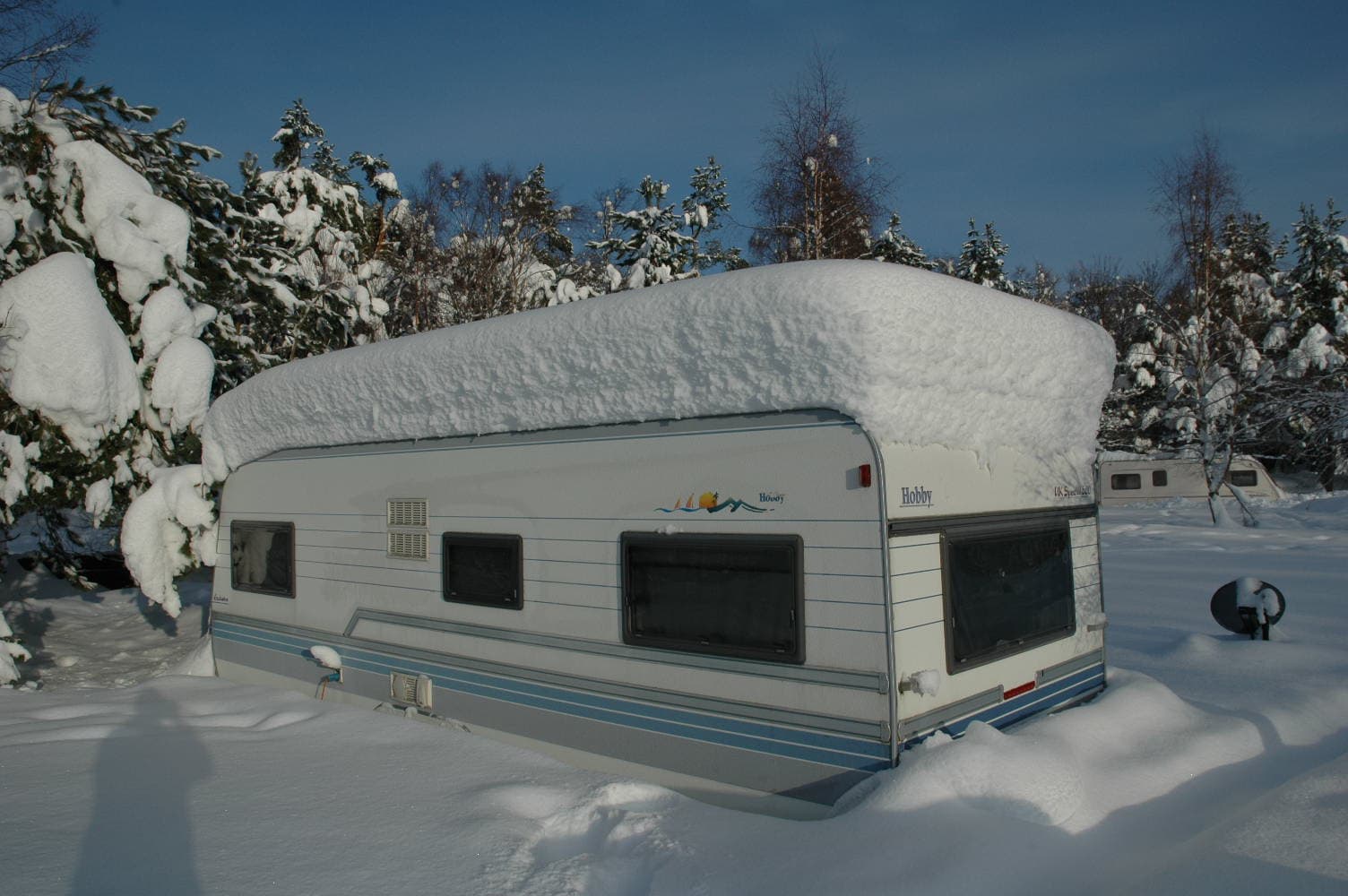
- Outside, a breathable cover made for caravans keeps off leaves and UV without trapping moisture. An ordinary plastic tarpaulin does the opposite: it holds in condensation and rubs the bodywork in the wind.
Tyres, chassis and handbrake
Left for months on the same spot, tyres flatten and age. Three ways to protect them, from best to simplest:
- Take the weight off the wheels with axle stands under the chassis, at the points the manufacturer specifies (see the manual), as Michelin advises. Careful: corner steadies steady the caravan but are not jacks, AL-KO reminds owners, so never use them to lift it.
- Or add pressure: at least 0.5 bar above your usual pressure, according to the ANWB, the Dutch motoring club. Remember to go back to the normal pressure before you set off.
- Keep the sun off: wheel covers cut down the UV that cracks the rubber.
Level the caravan, put chocks under the wheels, then release the handbrake: the ADAC, the German motoring club, recommends this so that it does not freeze in the on position. On a slope, keep chocks on both sides. While you are there, clean the hitch head and check how old the tyres are: the manufacture date is printed on the sidewall.
The battery: charged, disconnected, kept frost-free
Even disconnected from everything, a battery slowly loses its charge, and a flat lead-acid battery can freeze and be ruined for good. Before winter:
- charge it fully, on mains hook-up or while towing;
- switch it off at the isolator, or disconnect the negative terminal: an alarm, the charger's clock or a detector is enough to drain it in a few weeks;
- top it up regularly through the winter, or leave it on a maintenance charger. If the caravan is stored away from home, the simplest answer is often to take the battery out and keep it somewhere frost-free, as the ADAC advises.
A lithium battery has its own rules: many will not accept a charge below 0 °C. Follow its manufacturer's manual for the storage charge level and temperature.
Gas: cylinders off, outside and dry
Turn off the cylinders, disconnect them and take them out of the gas locker. Store them upright in a cool, dry, well-ventilated place, and never in a cellar or basement: butane and propane are heavier than air and would collect at floor level if there were a leak. At a storage site, follow the site rules: many require cylinders to be removed or kept separately because of the fire risk.
Planning to use the caravan this winter? Butane stops vaporising at around 0 °C: in cold weather, only propane works.
Fridge, cleaning and pests
- The fridge: empty it, clean it, dry it, then lock the door slightly ajar. Most caravan fridges, Dometic ones included, have a catch for exactly this; without it, mould sets in within a few weeks.
- Food: take out all food, tins included, drinks and anything that can freeze (washing-up liquid, creams, cleaning products). Crumbs attract mice.
- Cleaning: give it a thorough clean inside and out before you lock up. Bird droppings, tree sap and stuck-on leaves damage the bodywork. Dry the awning and camping furniture before putting them away.
- Seals: look at the seals around rooflights, windows and lights. A small leak over winter means a damaged wall by spring.
Outside, under cover or in storage: where to keep it
The best place is a dry garage or closed building, as both the ADAC and the Caravan and Motorhome Club point out: out of the weather, the UV and the reach of thieves. Failing that, an open shelter (barn, carport) already keeps off rain and sun. Outside, choose flat, hard ground away from trees, and add a breathable cover.
| Where | Advantages | What to check |
|---|---|---|
| At home, outside | Free, you can keep an eye on it | Deeds, estate rules or covenants, breathable cover, security devices |
| At home, under cover or in a garage | The best for the caravan | Door height and length, ventilation of the building |
| Open-air storage site | Fenced, often cheaper | Access and opening hours, lighting, CCTV, rules on gas cylinders |
| Indoor storage | Shelter and security | Price, winter access to charge the battery, the site's insurance |
The rules on where a caravan can be kept depend on the country, and often on your local council. If you store or tour in France, this is what French law says:
- On the land of your home, or in your own buildings and outbuildings, the French Planning Code allows a caravan to be stored “pending its next use” (article R111-50). The same goes for a shared caravan storage garage or a vehicle storage yard.
- On other land that is neither a campsite nor a shared storage garage, keeping a caravan there for more than three months a year, periods added together, needs prior notice to the town hall (déclaration préalable, article R421-23).
- In the street, a vehicle left in the same place for more than seven days, or less if a local order says so, is parked unlawfully (article R417-12 of the French Highway Code): a 2nd-class fine, and it can be towed away.
In the UK or Ireland, the rules are different: check with your local council, and read your deeds or estate rules, before keeping the caravan on your drive or in the street.
Insurance: do not cancel it
A caravan standing still can catch fire, be stolen, be damaged by a storm or a falling branch, or damage a neighbour's property. In France, the law even treats a trailer, “even when not hitched”, as a vehicle that must be insured (article L211-1 of the French Insurance Code). Wherever you live, call your insurer before winter:
- are you covered for theft, fire and storm damage at the place where the caravan is stored?
- does the policy require a security device, a locked building or an approved storage site?
- at a storage site, the site's insurance does not necessarily cover your caravan: check that your own policy covers it there, as the Caravan and Motorhome Club advises.
In spring: getting it back on the road
- Damp: go round the walls, corners and cupboards, and use your nose. A stain, a warped panel or a smell of mould means water is getting in: have the caravan checked for damp by a professional before it spreads.
- Water: close the drains and taps, and the water heater valve once it is above 7 °C. Fill up, then check that no joint leaks, under the sink and at the water heater. Flush the system through before drinking the water.
- Gas: check the date printed on the flexible hose and the state of the regulator, reconnect, then check for leaks (soapy water, or a check by a professional) before lighting anything.
- Tyres and brakes: set the normal pressure, with the tyres cold, and check their age and any cracking. Test the brakes at low speed; if the caravan has not been serviced for a while, have the brakes and bearings checked.
- Battery and lights: charge it, reconnect it, then check all the lights with the car hitched up.
Fancy getting away before summer? The Open all year filter shows only the campsites that welcome you in winter. And if you spend part of the winter at one of them, tell other Nesters how access went with your caravan: you can do it on the campsite's page.
The checklist before you lock the door
Print it or keep it on your phone: everything to do, in order.
Water
- Fresh water tank drained, drain plug left open
- Water heater drained, drain valve open
- Taps and shower head open, mixers set halfway between hot and cold
- Pump and filter drained
- Waste water tank emptied, rinsed, valve left open
- Toilet cassette emptied, rinsed and dried
Inside
- Fridge emptied, cleaned, door wedged ajar
- Food, drinks and anything that can freeze taken out
- Cupboards, lockers and wardrobe left ajar, mattresses and cushions stood on edge
- Moisture traps in place, vents kept clear
Power and gas
- Gas cylinders turned off, disconnected, stored outside in a well-ventilated spot
- Battery charged and disconnected, or taken out and kept frost-free
Chassis and outside
- Caravan washed, seals and rooflights checked
- Chocks under the wheels, handbrake released once the caravan is chocked
- Weight taken off the wheels with axle stands, or tyres pumped up 0.5 bar above normal
- Breathable cover, hitch lock or wheel clamp
- Insurance checked for the place where it is stored
Frequently asked questions
When should I winterise my caravan?
Before the first frosty nights, even if it is kept in an unheated shelter. Water left in the pipes, the pump or the water heater expands as it freezes and can split parts: drain everything down as soon as you know you will not be going away again.
How do I drain a caravan water heater?
Turn off the heating and the water supply, open the taps halfway between hot and cold, then open the water heater's drain valve or tap. On a Truma, the FrostControl valve opens by itself at about 3 °C and can only be closed again above about 7 °C; open it yourself anyway. For other makes, follow the manual.
Should I leave the handbrake on while the caravan is laid up?
No: once the caravan is chocked, with chocks under the wheels, release it. The ADAC advises this so that it does not freeze in the on position. On a slope, keep chocks on both sides.
How do I stop damp in a caravan over winter?
Keep the vents clear, leave cupboards, lockers and the fridge ajar, stand cushions on edge or take them out, put out moisture traps and air the caravan on dry days. Outside, use a breathable cover, never a plastic tarpaulin.
Can I keep my caravan in my garden all winter?
It depends on the country and often on your council, deeds or estate rules, so check them first. In France, article R111-50 of the Planning Code allows a caravan to be stored on the land of your home, or in your buildings, pending its next use; in the street, it cannot stay in the same place for more than seven days.
Should I keep my caravan insured over winter?
Yes. A caravan standing still can be stolen, catch fire or cause damage, and in France the Insurance Code treats a trailer, even when not hitched, as a vehicle that must be insured. Check with your insurer what cover and conditions (security device, locked building) apply where it is stored.
Sources (4)
- French Planning Code (Code de l'urbanisme), article R111-50 (storing caravans) – Légifrance
- French Planning Code (Code de l'urbanisme), article R*421-23 (prior notice, caravans for more than three months a year) – Légifrance
- French Highway Code (Code de la route), article R417-12 (unlawful long-term parking) – Légifrance
- French Insurance Code (Code des assurances), article L211-1 (compulsory insurance, trailers) – Légifrance
Sources checked on the date of the last update. Rules change: check the official text before you set off.